Why Does a Plumber Cost More Than a Handyman? (The Insurance Factor)
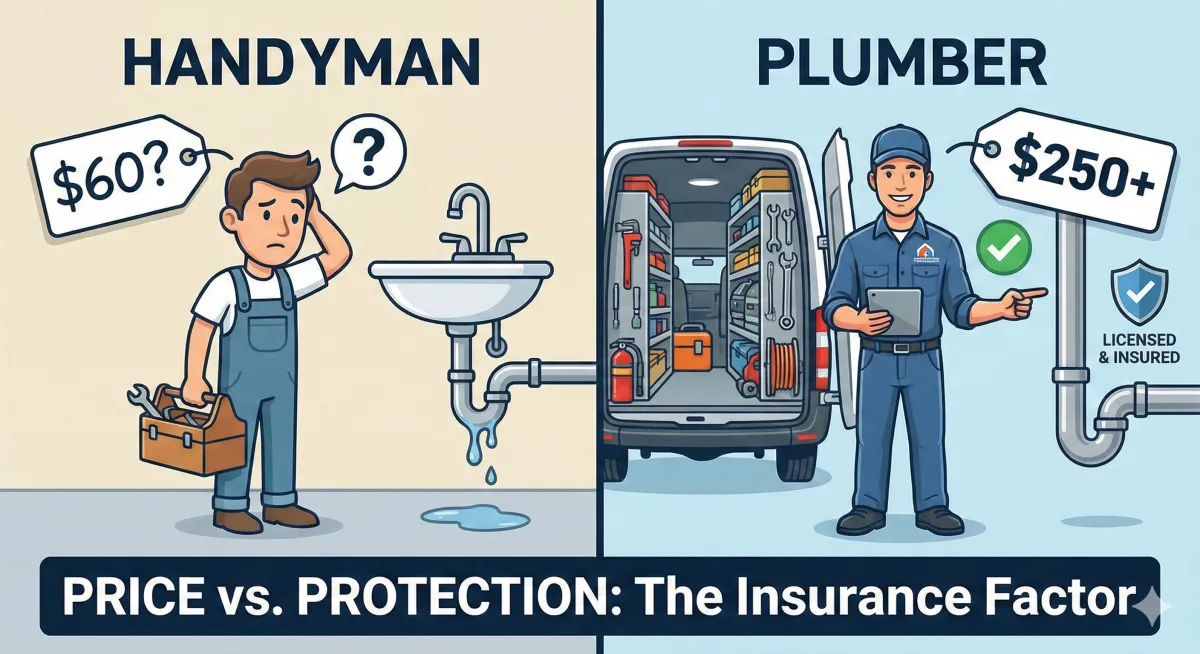
You have a leak under your kitchen sink. You call a local handyman, and he says he can fix it for $60. You call a professional plumbing company, and their quote is significantly higher.
It’s tempting to go with the cheaper option. After all, it’s just a pipe, right? Why should you pay three times as much for the same result?
Here is the hard truth that most homeowners in Florida don’t realize until it’s too late: You aren't paying for the same result.
When you hire a licensed plumber, a huge portion of that fee goes toward insurance and liability protection. When you hire a handyman for plumbing work, you are often accepting 100% of the financial risk. If a pipe bursts or a worker gets hurt, "saving" $100 could cost you your home.
Here is the breakdown of why a professional plumber costs more—and why that cost is actually your safety net.
1. The "Illegal Plumbing" Reality in Florida
The first thing to understand is that in the state of Florida, it is illegal for a handyman to perform most plumbing work.
Handymen are great for painting, hanging drywall, or assembling furniture. But according to Florida statutes, a handyman cannot legally install a dishwasher, replace a water heater, or modify any pipe that connects to your water supply or sewage system.
Why does this affect the price?
The Plumber: Has spent years as an apprentice, passed rigorous state board exams, and pays annual licensing fees to the state of Florida to operate legally.
The Handyman: Has no oversight.
When you pay a plumber, you are paying for the guarantee that the work meets state building codes. If a handyman does the work illegally and you try to sell your house later, a home inspector will flag the unpermitted work, forcing you to pay a plumber to rip it out and redo it anyway.
2. The Insurance Factor: Who Pays When Things Go Wrong?
This is the single biggest differentiator in cost. Professional plumbing companies carry two critical types of insurance that protect you.
General Liability Insurance
The Plumber: If we solder a pipe and accidentally scorch your cabinet, or if a compression fitting fails overnight and floods your kitchen, our General Liability insurance covers the damages. We pay to fix your house.
The Handyman: Most handymen carry basic liability policies (if any). However, insurance policies have strict "exclusions." If a handyman’s policy excludes "plumbing operations" (because he isn't a licensed plumber), his insurance company will deny the claim. You will be left paying for the flood remediation out of pocket.
Workers' Compensation
The Plumber: Plumbing is physical work. If one of our technicians slips on a wet floor or hurts their back while carrying a water heater into your garage, our Workers' Compensation insurance pays for their medical bills.
The Handyman: If a self-employed handyman gets hurt on your property, he rarely has Workers' Comp. In the eyes of the law, he may be considered your "employee" for the day. That means you could be sued for his medical bills and lost wages.
The premium for a plumber is higher because we are removing that liability from your shoulders.
3. The "Truck Stock" Difference
When a handyman arrives, he usually brings a toolbox. If he needs a part, he has to leave, drive to the hardware store, buy the part, and come back. You are often paying for that travel time.
When a professional plumber arrives, he brings a warehouse on wheels. Our trucks are stocked with thousands of dollars in specialized tools, brass fittings, valves, and seals.
We have the leak detection equipment to find the problem behind the wall without destroying it.
We have the hydro-jetters to clear the clog, not just poke a hole in it.
You are paying for the capital investment of that fully stocked truck, which ensures the job is done in one trip, not three.
4. The Diagnostic: Treating the Disease, Not the Symptom
A handyman fixes what he sees. A plumber fixes what is causing the problem.
Example: You have a slow drain.
The Handyman: Pours chemical cleaner down the drain or uses a small hand snake. It clears for a week, then clogs again. You pay him $60.
The Plumber: Uses a sewer camera to see that a tree root has penetrated your pipe. We recommend a permanent fix.
The handyman is cheaper in the short term, but you will call him five times. The plumber is more expensive once, but the problem is solved forever.
Conclusion: Peace of Mind Has a Price
We love handymen—they are essential for general home maintenance. But when it comes to the systems that control water, gas, and sewage in your home, the stakes are too high for a "Jack of All Trades."
The price difference between a plumber and a handyman isn't profit; it's protection. It covers the license that ensures legality, the insurance that protects your assets, and the training that guarantees the safety of your family.
Don't gamble your home to save a few dollars. Next time you have a plumbing issue, hire the team that is licensed, insured, and ready to stand behind their work.
Need a pro you can trust? Schedule your service with My Plumbing Friends today. We do it right, we do it legally, and we keep your home safe.

Facebook
Instagram