The Garbage Disposal Rules: What You Should Never Put Down the Drain
It happens every year around the holidays. The table is cleared, the dishes are being rinsed, and someone scrapes a plate full of potato peels and turkey bones directly into the sink. You flip the switch, hear a sickening crunch-hummmm, and silence. The water starts to back up. The party is over, and the plumbing emergency has begun.
At My Plumbing Friends, we install and repair hundreds of garbage disposals every year. The vast majority of these repairs aren't caused by mechanical failure or old age—they are caused by "user error."
Many homeowners treat their garbage disposal like a trash compactor or a high-powered blender. But the reality is, your disposal is a delicate instrument designed for small, soft food scraps. Understanding what belongs in the trash can versus the sink is the single best way to avoid a messy backup and an expensive repair bill.
In this guide, we’re breaking down the ultimate "Naughty and Nice" list for your kitchen sink, explaining exactly why certain items cause chaos, and how to keep your disposal running smoothly for years.
How Your Disposal Actually Works (It’s Not a Blender)
To understand the rules, you first need to understand the mechanism.
Contrary to popular belief, your garbage disposal does not have spinning knives or blades like a blender. Instead, it uses a spinning plate with metal "impellers" (lugs) that throw food against a stationary grind ring. This ring works like a cheese grater, shredding food into small particles that can pass through your pipes.
Because it relies on centrifugal force and shredding rather than slicing, it struggles with anything that is too hard, too stringy, or too sticky. If the food can't be grated into liquid, it will eventually clog your drain.
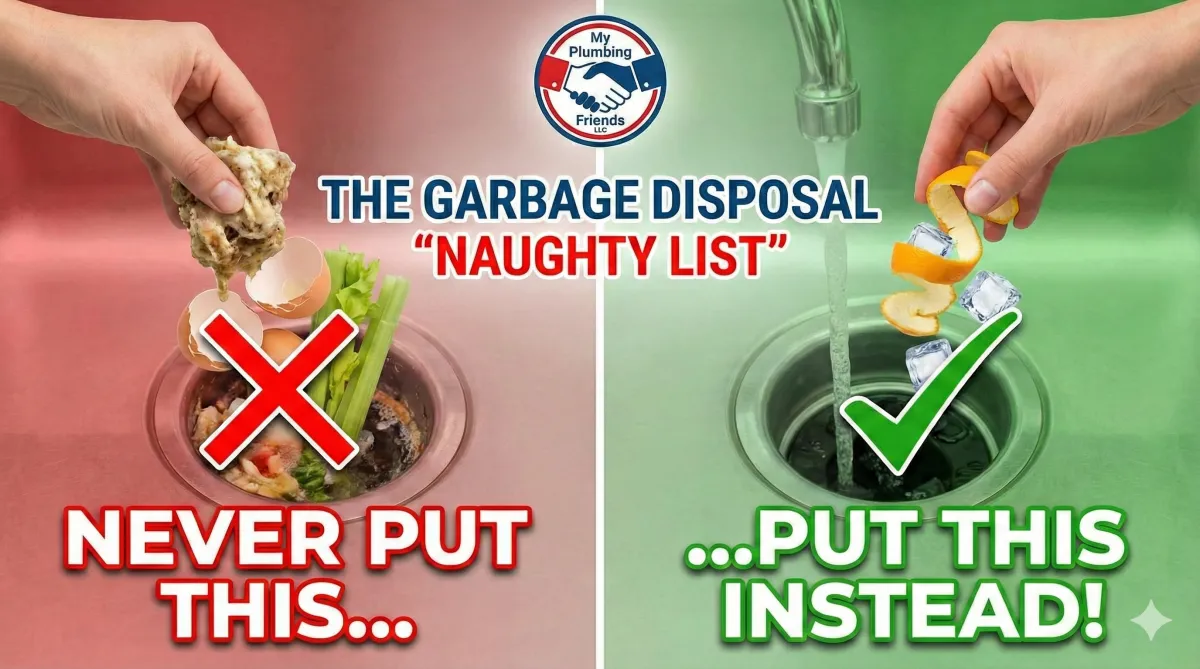
The "Naughty List": 6 Things to Never Put Down the Disposal
If you want to avoid a service call, memorize this list. These are the top offenders we see when we respond to clogged kitchen sink calls.
1. Fats, Oils, and Grease (F.O.G.)
This is the number one enemy of plumbing everywhere. When you pour hot bacon grease or roasting pan drippings down the drain, it flows smoothly at first. But as soon as it hits your cold pipes, it solidifies into a hard, waxy block.
The Result: It doesn't just jam the disposal; it coats the inside of your sewer lines, narrowing them until nothing can pass through. The Fix: Pour grease into an old can or jar, let it freeze or harden, and throw it in the trash.
2. Fibrous Vegetables (Celery, Corn Husks, Artichokes)
Vegetables that are stringy are kryptonite for disposals. The long fibers (think of the strings on a stalk of celery) can slip past the grinding ring and wrap themselves around the motor shaft or the impellers.
The Result: The tangled fibers can bind the motor, causing it to burn out or trip the safety breaker. The Fix: Compost these items or toss them in the trash. Even small amounts can build up over time.
3. Coffee Grounds
This is the most controversial item on the list because grounds look small enough to pass through. However, coffee grounds are dense and oil-heavy. They don't dissolve in water; they clump together.
The Result: In your pipes, coffee grounds act like sediment in a river. They settle in the "trap" (the U-shaped pipe under the sink) and create a thick, sludge-like paste that is incredibly difficult to clear. The Fix: Your garden loves them! Use coffee grounds as fertilizer or throw them in the compost.
4. Eggshells
There is a myth that grinding eggshells "sharpens the blades." This is false (remember, there are no blades!).
The Result: The inner membrane of the eggshell is sticky and tough. It can peel off and wrap around the shredder ring. Meanwhile, the shell itself grinds down into a sand-like substance that sits in your pipes and catches other debris, leading to slow drains. The Fix: Compost them.
5. Starchy Foods (Pasta, Rice, Potato Peels)
Rice and pasta do one thing very well: they expand when wet. Even after they are cooked, they continue to absorb water.
The Result: A cup of pasta or potato peels can turn into a thick, glue-like paste inside your disposal. This paste fills the voids in the grind ring and the drain pipe, creating a blockage that water cannot push through. The Fix: Scrape all starchy leftovers into the trash before rinsing the plate.
6. Bones and Fruit Pits
While some high-end "heavy duty" disposals claim they can handle chicken bones, it is rarely worth the risk.
The Result: Hard objects bounce around the grind chamber, chipping the components or jamming the plate so it can't spin. If a shard gets through, it can get stuck in the pipe curve. The Fix: Only put soft food scraps down the sink.
The "Nice List": What CAN Go Down?
Your disposal isn't useless! It is perfect for cleaning up the small bits that remain after you've scraped the main scraps into the trash.
Citrus Rinds: Small pieces of lemon or orange peel are great. They grind easily and the natural oils help clean the unit and freshen the smell.
Fruit Scraps: Soft pieces of banana, apple (without seeds), or berries.
Vegetable Scraps: Ends of carrots, cucumbers, or zucchini (non-fibrous).
Ice Cubes: Occasional ice cubes are actually good for the disposal. They help knock off debris stuck to the impellers.
Troubleshooting: What to Do If It Jams
If you accidentally slip up and the disposal stops working, don't panic. You might be able to fix it without a plumber.
Turn it off: Flip the wall switch to OFF.
Check the Reset Button: Look under the sink at the bottom of the disposal unit. There is a small red button. If it has popped out, press it back in.
Use the Key: Most disposals come with a small hexagonal "jam buster" wrench (an Allen wrench). Insert it into the hole in the very center of the bottom of the unit. Wiggle it back and forth to manually unjam the plate.
Test: Turn the water on and try the switch again.
WARNING: Never, under any circumstances, put your hand inside the disposal to dislodge an object, even if it is turned off.
Conclusion: Treat Your Kitchen Plumbing Like a Friend
Your garbage disposal is a workhorse, but it has its limits. By following these simple rules—keeping the "Three Gs" (Grease, Grinds, and Garbage) out of your sink—you can extend the life of your appliance and avoid the headache of a flooded kitchen.
However, even with the best care, disposals eventually wear out. Motors weaken, seals leak, and blades dull. If your disposal is humming but not grinding, or leaking from the bottom, it’s time for a replacement.
Is your kitchen sink making strange noises or refusing to drain?
Don't let a jammed disposal ruin your dinner plans. Whether you need a quick repair or a high-quality replacement installed, we are here to help.
Contact My Plumbing Friends today to schedule a service. We’ll get your kitchen running smoothly again so you can get back to cooking!

Facebook
Instagram