The "Flushable" Wipes Myth: What Actually Happens to Your Pipes
The Definition Trap: "Flushable" vs. "Biodegradable"
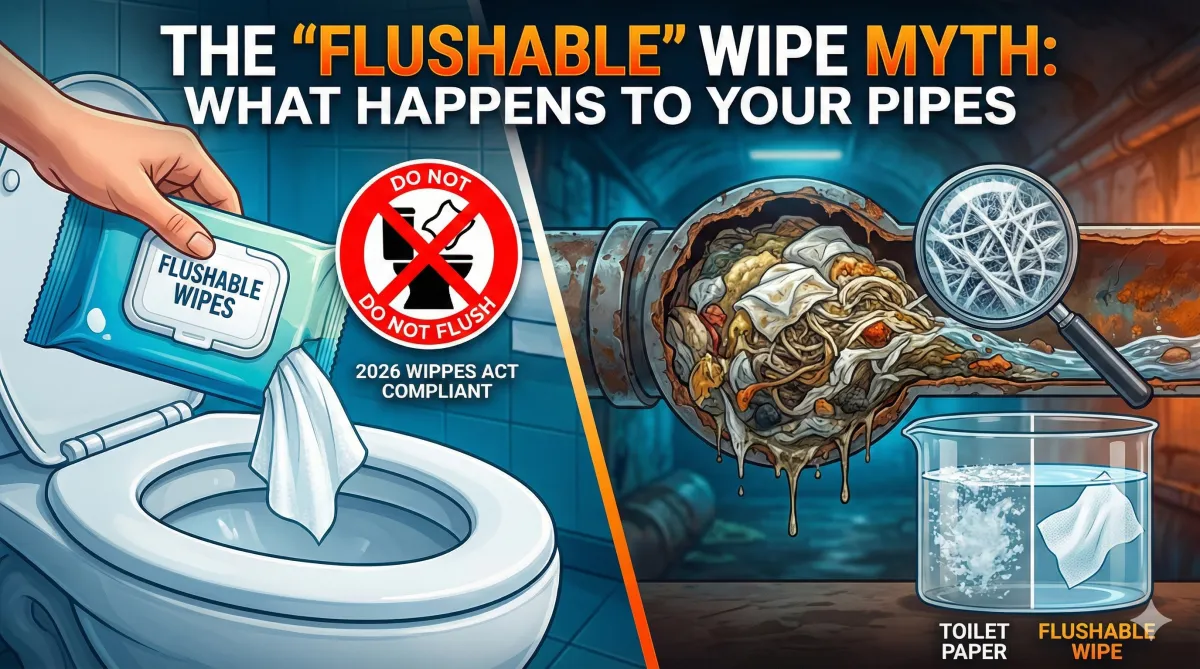
The Science: The "Water Glass" Test
The "Fatberg" Menace: When Wipes Meet Grease
The Special Risk for Septic Owners
It is a Saturday night scenario we see constantly in Cape Coral and Fort Myers: A homeowner has a house full of guests, the toilets are working overtime, and suddenly, water starts rising instead of draining. The culprit? Often, it is a small, harmless-looking square of fabric labeled "flushable."
If you have walked down the toilet paper aisle in 2026, you have likely noticed a change. Thanks to new legislation like the WIPPES Act and various state mandates taking full effect this year, manufacturers are finally being forced to slap giant "DO NOT FLUSH" symbols on most wipes.
But confusion remains. Many brands still claim their specific technology is "septic safe" or "plumber approved."
As the plumbing experts who have to physically remove these from your sewer line, we are here to set the record straight. Here is the unvarnished truth about what "flushable" wipes actually do to your home’s infrastructure and why they are the number one enemy of your plumbing system.
The Definition Trap: "Flushable" vs. "Biodegradable"
How can companies legally use the word "flushable" if the product ruins pipes? It comes down to a marketing technicality versus a physical reality.
To a manufacturer, "flushable" simply means the item will clear the curve of your toilet bowl and disappear from sight. It does not mean it will break down in the pipes.
Think of it this way: Your wedding ring is technically "flushable." A golf ball is "flushable." But neither belongs in your sewer system.
Unlike toilet paper, which is designed to dissolve into a slurry within seconds of hitting water, wipes are made with synthetic fibers (like polyester or rayon) bound together to be durable. They are designed not to fall apart while you use them. Unfortunately, that durability doesn't magically vanish once you hit the flush handle.
The Science: The "Water Glass" Test
You don't just have to take our word for it. You can perform a simple science experiment in your kitchen right now to see why we recommend professional drain cleaning so often.
Bowl A: Place a few sheets of toilet paper in a bowl of water. Swirl it with a spoon for 10 seconds.
Result: It turns into a cloud of pulp.
Bowl B: Place a "flushable" wipe in a bowl of water. Swirl it for 10 seconds. Swirl it for an hour. Swirl it for a week.
Result: It remains a pristine, solid rag.
That solid rag is exactly what is sitting in your pipe right now. When it catches on a small imperfection in your sewer line—like a tree root or a rough joint—it acts as a net, catching other debris until a full blockage forms.
The "Fatberg" Menace: When Wipes Meet Grease
The problem gets exponentially worse when wipes leave your home and enter the municipal sewer system.
When wipes combine with FOG (Fats, Oils, and Grease) that people pour down their kitchen sinks, they undergo a chemical process called saponification. They turn into a hard, concrete-like mass known as a Fatberg.
These masses can grow to the size of SUVs. In Florida, where our flat geography requires lift stations to pump sewage against gravity, these wipes clog the pumps, leading to massive municipal repairs and, eventually, higher water bills for everyone.
Warning: If you hear a gurgling sound coming from your toilet or shower drain, this is often the first sign that a blockage is forming deep in your main line. Do not wait for a complete backup; schedule a camera inspection immediately to identify the obstruction.
The Special Risk for Septic Owners
For our customers on septic systems, the risk is double.
In a municipal system, you might get lucky, and the wipe might float all the way to the treatment plant (becoming the city's problem). In a septic tank, there is nowhere for it to go.
Since the wipe does not break down, it settles at the bottom of your tank as sludge or floats to the top as scum. This rapidly fills your tank capacity, requiring much more frequent pumping. Worse, if a wipe flows out into your drain field, it can clog the perforated pipes that leach water into the soil.
Replacing a failed drain field can cost upwards of $10,000 to $20,000. Using a trash can instead of the toilet costs $0.
What If I Have Already Flushed Them?
If you have been flushing wipes for years and haven't had a problem, you are essentially playing Russian Roulette with your sewer line. The buildup is likely already there, silent and growing.
Immediate Steps to Take:
The "Trash Can" Rule: Place a small bin with a lid next to every toilet. This is the only safe disposal method for wipes, dental floss, and feminine hygiene products.
Hydro Jetting: If you have a history of flushing wipes, traditional "snaking" might not be enough. A snake often just punches a hole through the blockage. To truly clean the pipes, we recommend hydro jetting. This uses high-pressure water streams to scour the inside of your pipes, cutting through wipe clumps and grease buildup to restore the pipe to "like-new" condition.
Check Your Cleanouts: Ensure your external cleanout caps are accessible so that if a blockage does occur, our team can access the line without dragging equipment through your house.
Conclusion
The convenience of a wet wipe is undeniable, but the cost of a sewer backup is devastating. In 2026, the verdict from the plumbing community is unanimous: No wipe is truly flushable.
Protect your home, your wallet, and your city's infrastructure by keeping the "Three Ps" rule: Flush only Pee, Poo, and (Toilet) Paper.
Worried About What’s In Your Pipes?
If you have been flushing wipes and notice your drains are slower than usual, don't wait for the inevitable backup.
Let’s clear the path before disaster strikes. My Plumbing Friends uses advanced camera technology to show you exactly what is happening underground. Contact us today to schedule a sewer inspection and get peace of mind that your plumbing is flowing freely.

Facebook
Instagram