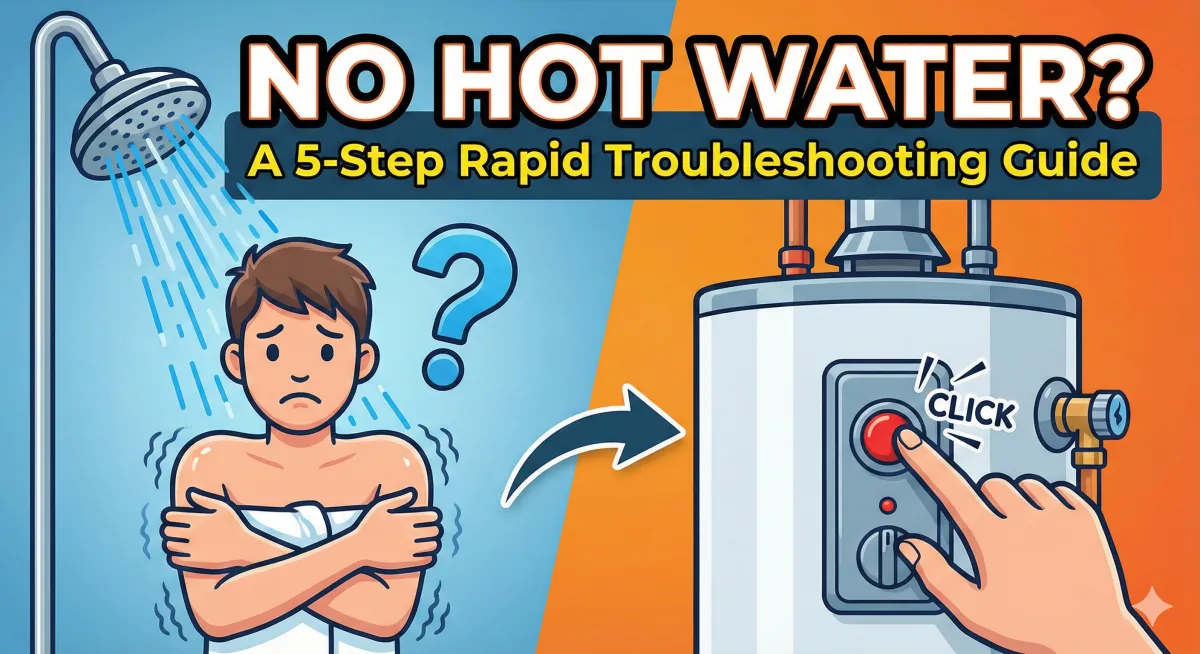
No Hot Water? A 5-Step Rapid Troubleshooting Guide
There is perhaps no rude awakening quite like stepping into a morning shower, expecting a warm embrace, and being hit with a blast of arctic water instead. It’s the kind of start to the day that sends homeowners into a panic. Is the water heater broken? How much will this cost? Do I need to call a plumber right now?
Before you start worrying about the cost of a replacement unit, take a deep breath. In many cases, a lack of hot water is caused by a minor safety trip or a simple setting error that you can fix yourself in minutes.
In this guide, we will walk you through a 5-step rapid troubleshooting process to diagnose why your water heater has gone cold. We will cover both electric and gas systems, help you distinguish between a simple reset and a major failure, and get your hot water flowing again.
Safety First: Read This Before Touching Anything
Water heaters combine high-voltage electricity or combustible gas with water under pressure. This combination demands respect. Before you begin troubleshooting:
For Electric Heaters: Always ensure your hands are dry. If you are inspecting wiring or elements, you must shut off the power at the circuit breaker panel first.
For Gas Heaters: If you smell gas (a rotten egg odor) near the unit, stop immediately. Do not flip any switches or light any matches. Leave the house and call your gas company or emergency services.
The T&P Valve: Never cap or plug the Temperature and Pressure (T&P) relief valve if it is leaking. This valve prevents your tank from exploding due to pressure buildup.
If you are ever unsure or uncomfortable performing these checks, it is always safer to schedule a professional plumbing inspection rather than risking injury.
Step 1: The "Power Check" (Electric & Gas)
It sounds obvious, but you would be surprised how often a cold shower is caused by a simple power interruption rather than a mechanical failure.
For Electric Water Heaters: Check the Breaker
Electric water heaters draw a significant amount of power. Occasionally, a power surge or a momentary overload can trip the circuit breaker.
Go to your home’s electrical panel (breaker box).
Look for the breaker labeled "Water Heater" or "Hot Water." It is usually a double-pole breaker (takes up two slots).
If the switch is in the "Off" position or stuck in the middle "Neutral" position, flip it all the way to "Off" and then firmly back to "On."
Wait 30–60 minutes to see if the water heats up.
For Gas Water Heaters: Check the Gas Valve
If you have a gas unit, ensure the gas supply line hasn't been accidentally bumped into the "Off" position. The handle on the gas line should be parallel to the pipe (open). If it is perpendicular (crossing the pipe), it is closed.
Step 2: The "Magic Button" (Electric Only)
If your breaker is fine but you still have no hot water, your water heater’s internal safety switch might have tripped. This is known as the High-Limit Switch or the ECO (Emergency Cut Off). It is designed to cut power if the water temperature inside the tank gets dangerously high (usually above 180°F).
How to Reset the ECO:
Turn off the power to the water heater at the circuit breaker. This is non-negotiable.
Locate the upper access panel on the side of your water heater tank.
Remove the screws and take off the metal cover. You may need to peel back a piece of insulation.
Look for a red button on the thermostat unit.
If the button has popped out, press it firmly until you hear a "click."
Replace the insulation and cover plate, then turn the power back on.
Pro Tip: If this button trips once, it might be a fluke. If it trips again shortly after resetting, do not keep pressing it. This indicates a deeper electrical issue, likely a stuck thermostat or a grounded element, which requires water heater repair.
Step 3: The Pilot Light Inspection (Gas Only)
For gas water heaters, the most common culprit for cold water is a pilot light that has gone out. This small flame ignites the main burner when the water needs heating.
How to Check and Relight:
Look through the small glass viewing window at the bottom of the unit. Do you see a small blue flame?
If it’s dark, your pilot is out.
Locate the gas control knob on the front of the unit. Turn it to the "Pilot" position.
Hold down the knob (to release gas to the pilot) and simultaneously press the ignition button (usually red or black) repeatedly until you see a spark ignite the flame.
Crucial Step: Once lit, keep holding the knob down for at least 60 seconds. This heats up the thermocouple, a safety sensor that confirms a flame is present. If you let go too soon, the gas will cut off again.
Release the knob. If the flame stays on, turn the knob to "On."
If the pilot lights but goes out immediately after you release the knob, your thermocouple is likely dirty or bent. This is a common wear-and-tear issue in older units.
Step 4: The Thermostat Test
Sometimes the problem isn't that the heater isn't working—it's that it thinks its job is already done.
If the water is lukewarm but not hot, check your thermostat settings.
Electric: Most have two thermostats (upper and lower). They are hidden behind the access panels. Turn off the power before checking them. Ensure both are set to the same temperature, typically 120°F (49°C).
Gas: The dial is on the front control valve. Ensure it hasn't been bumped to the "Vacation" or "Low" setting.
Warning: Do not crank the temperature above 140°F to "force" it to work faster. This drastically increases the risk of scalding burns and can speed up sediment buildup inside the tank.
Step 5: The "Flush" Factor (Sediment Buildup)
If you have hot water, but it runs out after only 5 minutes, the issue likely isn't electrical—it's physical.
In areas with hard water (like the Tampa Bay area), minerals like calcium and magnesium settle at the bottom of the tank. Over time, this forms a thick layer of sediment.
In Gas Heaters: This sediment acts as an insulator between the burner at the bottom and the water. The heat struggles to get through, overheating the tank bottom and stressing the metal.
In Electric Heaters: The sediment can bury the lower heating element. If the element is buried in "sand," it will burn out quickly.
The Fix: You need to flush your tank. This involves connecting a garden hose to the drain valve at the bottom of the tank and letting the water run until it clears. If you hear "rumbling" or "popping" noises from your tank, this is a sure sign of sediment hardening inside. Regular water heater maintenance can prevent this buildup from killing your unit prematurely.
When to Call a Pro vs. DIY
You have checked the breaker, hit the reset button, and inspected the pilot light. What if there is still no hot water?
At this stage, the issue has likely moved beyond a simple reset and into part failure. Common components that fail include:
Heating Elements: If you have an electric heater and only get lukewarm water, usually the upper element works but the lower one has failed.
The Dip Tube: This plastic tube directs cold water to the bottom of the tank to be heated. If it breaks, cold water mixes with the hot water at the top, delivering a tepid shower.
Thermostat Failure: The brain of the unit is no longer telling the elements to turn on.
Furthermore, if you see any water leaking from the tank itself, troubleshooting is over. A leaking tank cannot be patched; it must be replaced immediately to prevent major water damage to your home.
The "2026" Perspective: Repair or Replace?
If your water heater is over 10 years old, putting money into new thermostats or elements is often throwing good money after bad. New 2026 energy regulations have made modern heat pump hybrids and tankless systems significantly more efficient. Swapping an aging unit for a tankless water heater could save you money on monthly energy bills while ensuring you never run out of hot water again.
Conclusion: Don't Settle for Cold Showers
Troubleshooting a water heater doesn't have to be a guessing game. By following these five steps—checking the power, resetting the ECO switch, inspecting the pilot, verifying the thermostat, and considering sediment buildup—you can often resolve the issue without spending a dime.
However, water heaters are complex appliances that work hard every single day. If your troubleshooting reveals a deeper issue, or if the unit keeps acting up despite your best efforts, it is time to bring in the experts.
Need Hot Water Fast?
You have done your part—now let us do ours. If your water heater is still leaving you in the cold, don't risk your safety or your weekend trying to force a fix.
Get your hot water restored today. Our team at My Plumbing Friends specializes in rapid water heater diagnostics and repair for Florida homeowners. Whether it's a quick part replacement or an upgrade to a high-efficiency system, we will give you an honest assessment and a fair price.
Schedule Your Water Heater Service Now or call us for emergency assistance!

Facebook
Instagram