Garbage Disposal Prices: Why the $100 Model Isn't Good Enough
You’re standing in the aisle of a big-box store, staring at a wall of garbage disposals. One box says $99. The one next to it says $350. They look almost identical. Naturally, you ask yourself: "Why should I pay three times as much for the same thing?"
It’s a fair question. But the truth is, they aren’t the same thing.
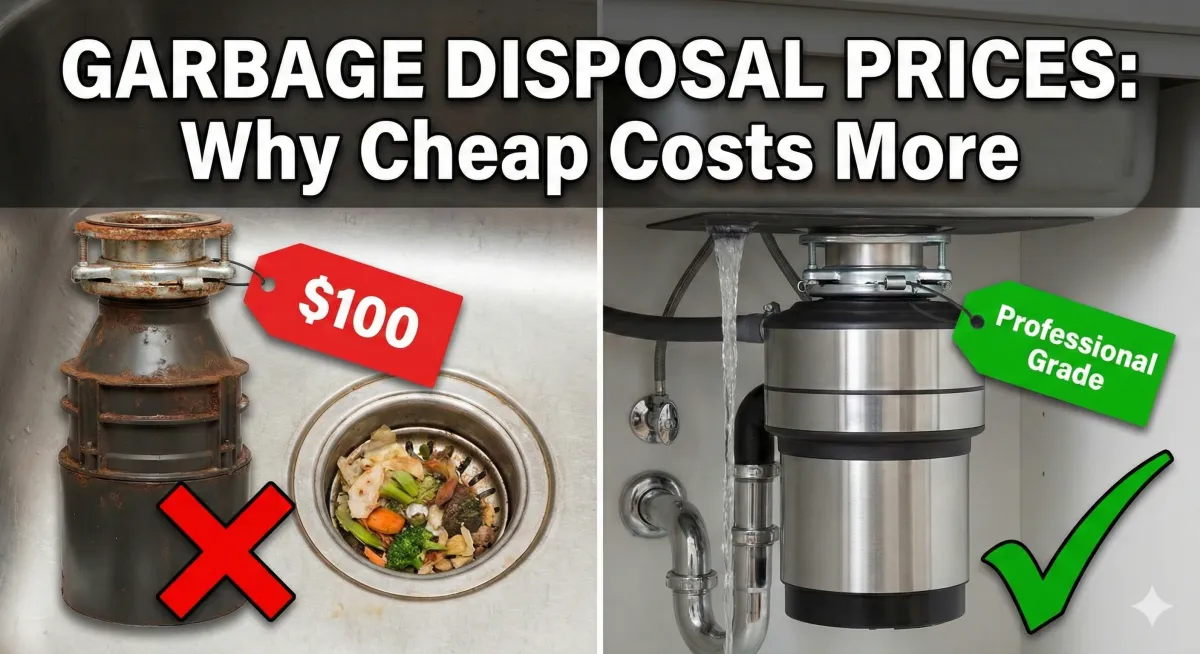
When it comes to garbage disposals, the price tag tells a story about what’s happening inside the machine. That $100 model is built for a specific purpose: to be cheap, disposable, and likely replaced in two years. The professional-grade model is built to chew through potato peels for the next decade.
If you are tired of jams, humming motors, and "mystery leaks" under your sink, it’s time to understand where your money actually goes when you invest in a quality garbage disposal installation.
The Hidden "Cost" of Cheap Disposals (Plastic vs. Metal)
The biggest difference between a budget disposal and a professional unit isn't the motor size—it's the grind chamber materials.
1. The Plastic Problem
Economy models (often found in the $80–$120 range) utilize plastic grind chambers and galvanized steel grinding components.
The Issue: Galvanized steel rusts. Plastic cracks. In Florida's humid environment, these units often develop rust rot within 2–3 years.
The Result: You might save $200 today, but you’ll be paying for a new unit and a new installation fee in 24 months.
2. The Stainless Steel Advantage
Professional-grade disposals (like the ones we install) feature stainless steel grind components.
The Benefit: Stainless steel doesn’t rust. It stays sharp longer and resists corrosion from acidic foods (like tomatoes or citrus).
The ROI: These units often last 10–12 years or more. When you do the math, paying $350 once is far cheaper than paying $120 four times.
Pro Tip: If the box feels suspiciously light, put it back. Heavy components mean metal, and metal means durability.
Horsepower Explained: Why Size Matters
Many homeowners assume that 1/3 Horsepower (HP) is "standard." In reality, 1/3 HP is the "bare minimum" required to spin the blades. It is not designed for a modern family kitchen.
1/3 HP: The "Builder's Grade" Special
These are often installed in new construction homes to save the builder money. They struggle with anything tougher than cereal or soft vegetables. If you try to grind carrot peels or small bones, they jam immediately.
1/2 HP: The Minimum Standard
This is better, but still liable to jam if you aren't careful. It’s suitable for a couple or a single person who doesn't cook from scratch often.
3/4 HP to 1 HP: The "Chef's Choice"
This is what we recommend for most families.
Torque: Higher horsepower provides the torque needed to snap small bones and grind fibrous material (like celery) without jamming.
Speed: They grind waste faster, meaning you run the water for less time, saving on your utility bill.
Noise: Surprisingly, higher HP motors are often quieter because they are insulated better and don't have to strain to do the job.
"Jam-Free" Technology: What Are You Paying For?
Have you ever turned on your disposal and heard that angry HUMMMMM sound? That’s the sound of a jammed flywheel.
Cheap disposals rely on a simple spinning plate. If a piece of bone gets wedged, the motor locks up. You then have to crawl under the sink with an Allen wrench to manually unjam it (assuming you can find the wrench).
Premium models feature auto-reverse technology. If the sensor detects a jam, the motor instantly spins in the opposite direction to dislodge the object. It happens so fast you usually won’t even notice. This feature alone saves homeowners from hundreds of dollars in "jammed disposal" service calls over the life of the unit.
The Installation Factor: Why DIY Costs More
YouTube makes installing a garbage disposal look like a 20-minute job. But there are three critical steps that DIYers often miss, leading to leaks and damage:
The Dishwasher Knockout Plug: If you connect your dishwasher to the disposal but forget to knock out the factory plug, your dishwasher will flood your kitchen the first time you run it. We see this happen constantly.
Vibration Dampening: Professional installation includes proper mounting to reduce vibration. Improperly mounted units can shake your sink loose or crack the putty seal, causing water to leak into your cabinets unnoticed for months.
The Plumbing Trap: Sometimes, a new, larger disposal changes the height of the drain pipe. If you force the PVC pipes to fit at an awkward angle, you create tension that will eventually crack the pipe or the disposal housing.
When you hire a professional, you aren't just paying for someone to screw in a machine. You are paying for the guarantee that your dishwasher will drain, your sink won’t leak, and your warranty will be valid.
Conclusion: Buy Nice or Buy Twice?
A garbage disposal is the workhorse of your kitchen cleanup. It deals with water, electricity, and sharp blades simultaneously. This is not the appliance to "go cheap" on.
While a $100 disposal might seem like a bargain, the lack of power, plastic parts, and high failure rate make it the most expensive option in the long run. Investing in a 3/4 HP or 1 HP unit with stainless steel components ensures you won’t be crawling under your sink to clean up a mess anytime soon.
Is your current disposal humming, leaking, or just refusing to grind?
You don’t have to guess which model is right for your home. We can assess your cooking habits and plumbing setup to recommend a unit that will last.
Stop fighting with a jammed sink. Get a Friend's Price First! Schedule your garbage disposal installation today and let us upgrade your kitchen with a professional-grade solution that handles the heavy lifting.

Facebook
Instagram